

- Carbon Emissions vs. Footprints: "Carbon emissions" refers to the release of gases like CO2 and methane, while a "carbon footprint" is the total sum of these emissions for a product or company.
- Three Scopes: Emissions are categorized into Scope 1 (direct), Scope 2 (energy), and Scope 3 (value chain). Scope 3 often makes up over 90% of a company's footprint.
- Activity-Based Measurement: Arbor uses a bottom-up approach that calculates emissions based on physical data (kg, kWh) rather than spend, offering higher accuracy.
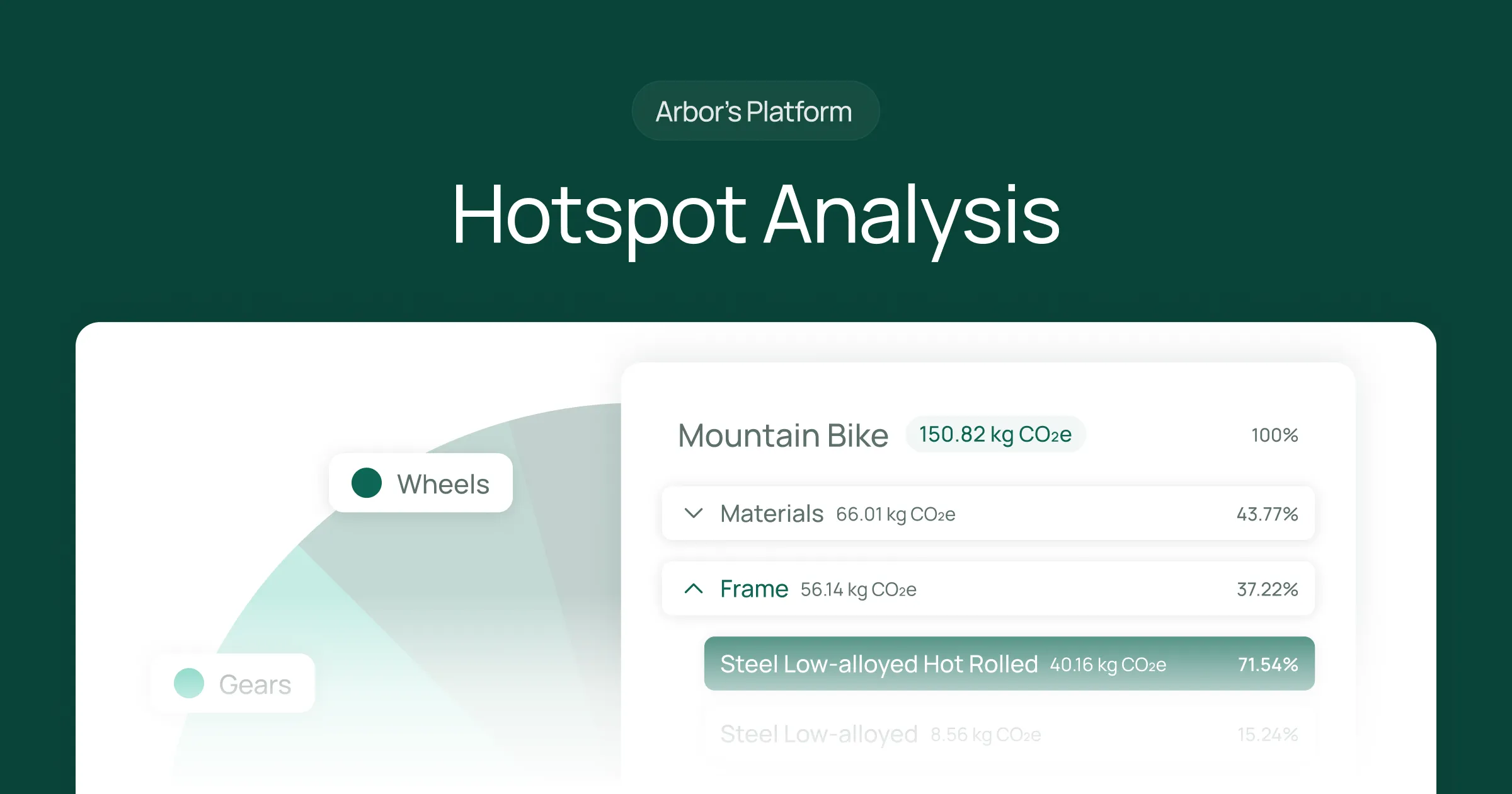
- Actionable Reduction: Tools from Arbor like Hotspot Analysis and Prototyping, help businesses identify high-impact areas and design lower-carbon products from the start.
- Business Growth: Transparent reporting builds trust with consumers and helps secure contracts with larger partners looking to decarbonize their own supply chains.
For years, sustainability lived in the marketing department. It was often treated as a yearly PDF filled with vague promises about the future. That era is over.
Today, carbon is closer to being a line item on the balance sheet, a requirement in RFPs, and a legal obligation in major markets.
For business leaders, "emissions" are an environmental concern and a data challenge.
If you sell products in the EU, operate in California, or supply to major retailers, you now need to account for your carbon emissions with the same effort you apply to your finances.
Here is a breakdown of what business emissions are, why regulations are tightening, and how to measure them accurately.
What are carbon emissions? Greenhouse gases vs carbon footprints
Before you can manage them, you need to define them. Carbon emissions generally refer to the release of greenhouse gases (GHGs) into the atmosphere from human activities, such as burning fossil fuels for energy, transportation, or manufacturing.
To discuss this accurately, business leaders must distinguish between three common terms often used interchangeably:
Greenhouse Gases (GHGs)
These are the physical gases that trap heat in the atmosphere.
While Carbon Dioxide (CO2) is the most common, this category also includes Methane, Nitrous Oxide, and others.
Carbon Emissions
This is the shorthand for the release of these gases. To make reporting simple, all various GHGs are converted into a single metric called CO2e (Carbon Dioxide Equivalent).
This allows you to compare the impact of methane from a landfill to the impact of diesel burned in a truck.
Carbon Footprint
This is the total sum of emissions attributed to a specific entity over a specific period.
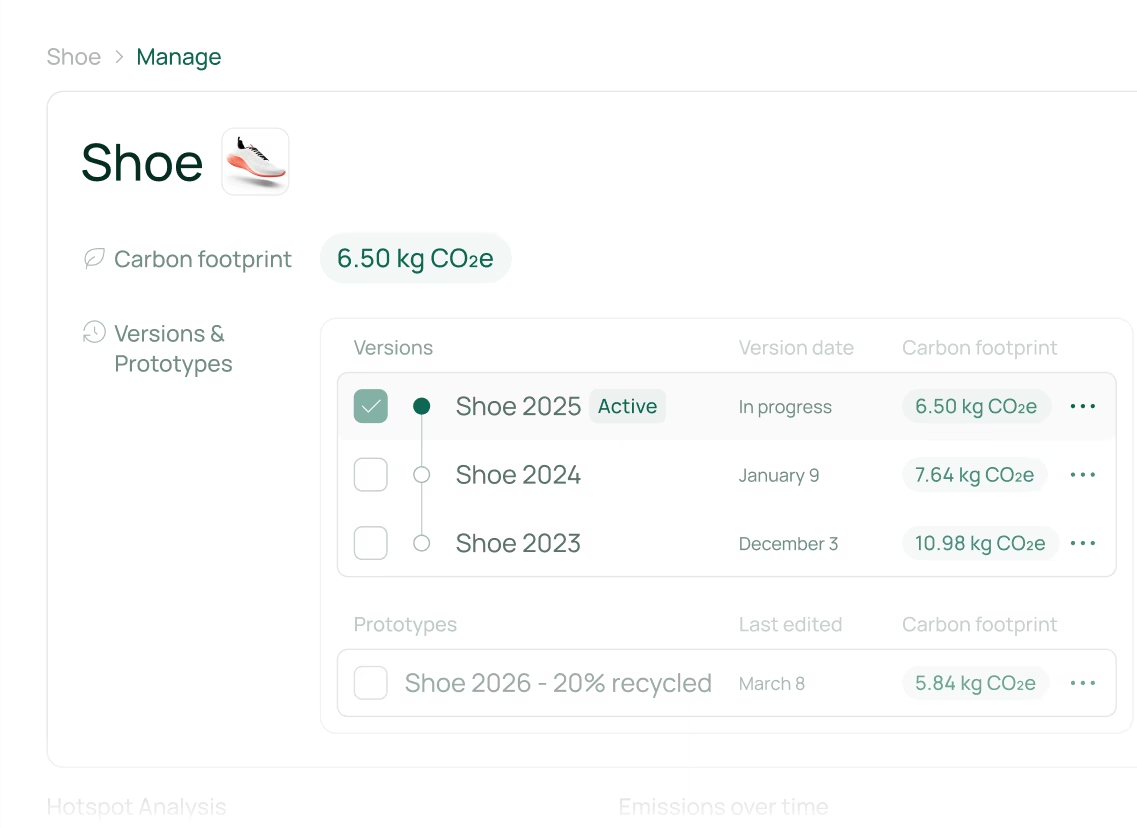
For example, a "product carbon footprint" measures the total impact of a single item, such as a shoe, from raw material extraction through disposal.
The Scope 3 problem: Where 90% of your risk hides
To make this data comparable and manageable, the global standard (the GHG Protocol) organizes emissions into three distinct categories, known as Scopes.

Scope 1: Direct emissions
Scope 1 emissions are the emissions released by sources your company owns or directly controls.
- Fuel combustion: Gas burned in your company's boilers or furnaces.
- Company vehicles: The exhaust from your owned fleet of delivery trucks or sales cars.
- Fugitive emissions: Leaks from refrigeration or air conditioning units on your property.
Scope 2: Indirect energy emissions
Scope 2 emissions cover the emissions generated from the production of the energy you purchase.
- Electricity: The power running your office lights and servers.
- Heating and Cooling: Steam or district heating is bought for your facilities.
You do not burn coal or gas yourself; your demand causes the power plant to do so.
Scope 3: The value chain (the big one)
Scope 3 emissions encompass all other indirect emissions that occur in your value chain, both upstream (suppliers) and downstream (customers).
- Purchased goods and services: The carbon footprint of the raw materials you buy, such as fabric, steel, or electronics.
- Transportation: Logistics providers shipping your goods via air, sea, or road.
- Use of sold products: The energy your product consumes when a customer uses it.
- End-of-life: What happens to your product when it is thrown away?
Why it matters:
For most product-based companies, especially in retail and apparel, Scope 3 accounts for up to 95% of your total organizational carbon footprint. If you only measure Scopes 1 and 2, you are ignoring the vast majority of your actual impact.
Why spend-based math fails your climate strategy
Measuring carbon emissions is not as simple as reading a meter. It requires complex data ingestion. The accuracy of your report depends entirely on the methodology you choose.
Many companies start with "spend-based" calculations. In this model, you multiply the dollars spent on a material by a generic global average.
This is a dangerous trap for a climate strategy.
Spend-based calculations often incentivize the wrong behaviour. If you switch to a higher-quality, sustainable material that costs more, a spend-based model will oddly show your carbon footprint going up because your financial spend increased. It penalizes you for doing the right thing.
The bottom-up advantage
Arbor uses a "Bottom-Up" approach, also known as activity-based measurement. Instead of looking at dollars, we look at physical activities.
- How it works: You calculate emissions based on the kilograms of material used, the kilowatt-hours of energy consumed, and the kilometres travelled.
- The benefit: This method uses specific emission factors backed by data partners like ecoinvent. It tells you exactly how much CO2e is released by producing 1kg of cotton in Turkey versus 1kg of polyester in China.
- The result: You get a granular view of your supply chain that reflects reality, not just your budget.
From reporting to reduction: finding your hotspots
Once you have an accurate measurement, the conversation shifts from compliance to strategy.
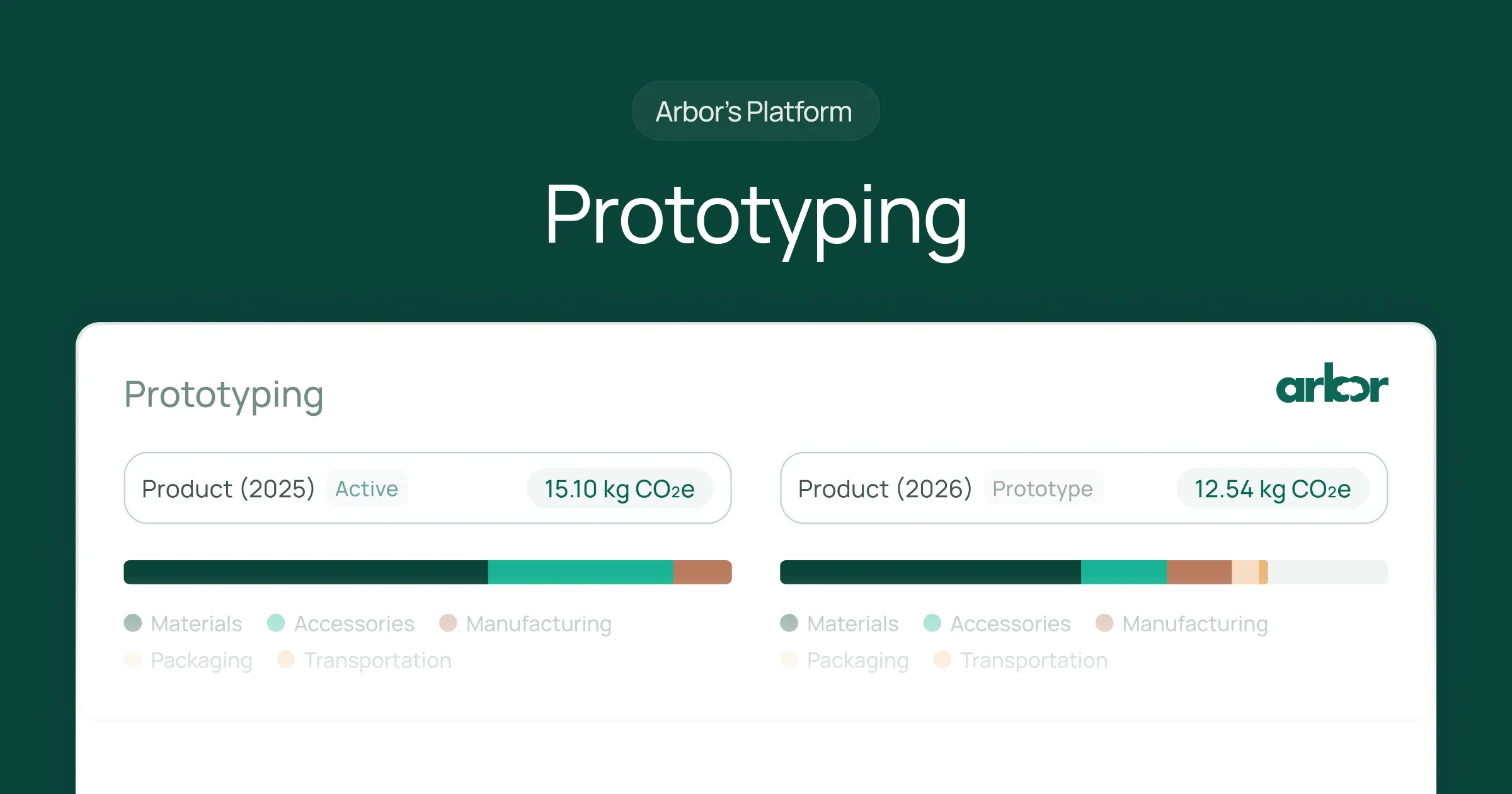
Arbor’s platform empowers companies to move beyond static reports and proactively reduce emissions with tools like Arbor’s prototyping.
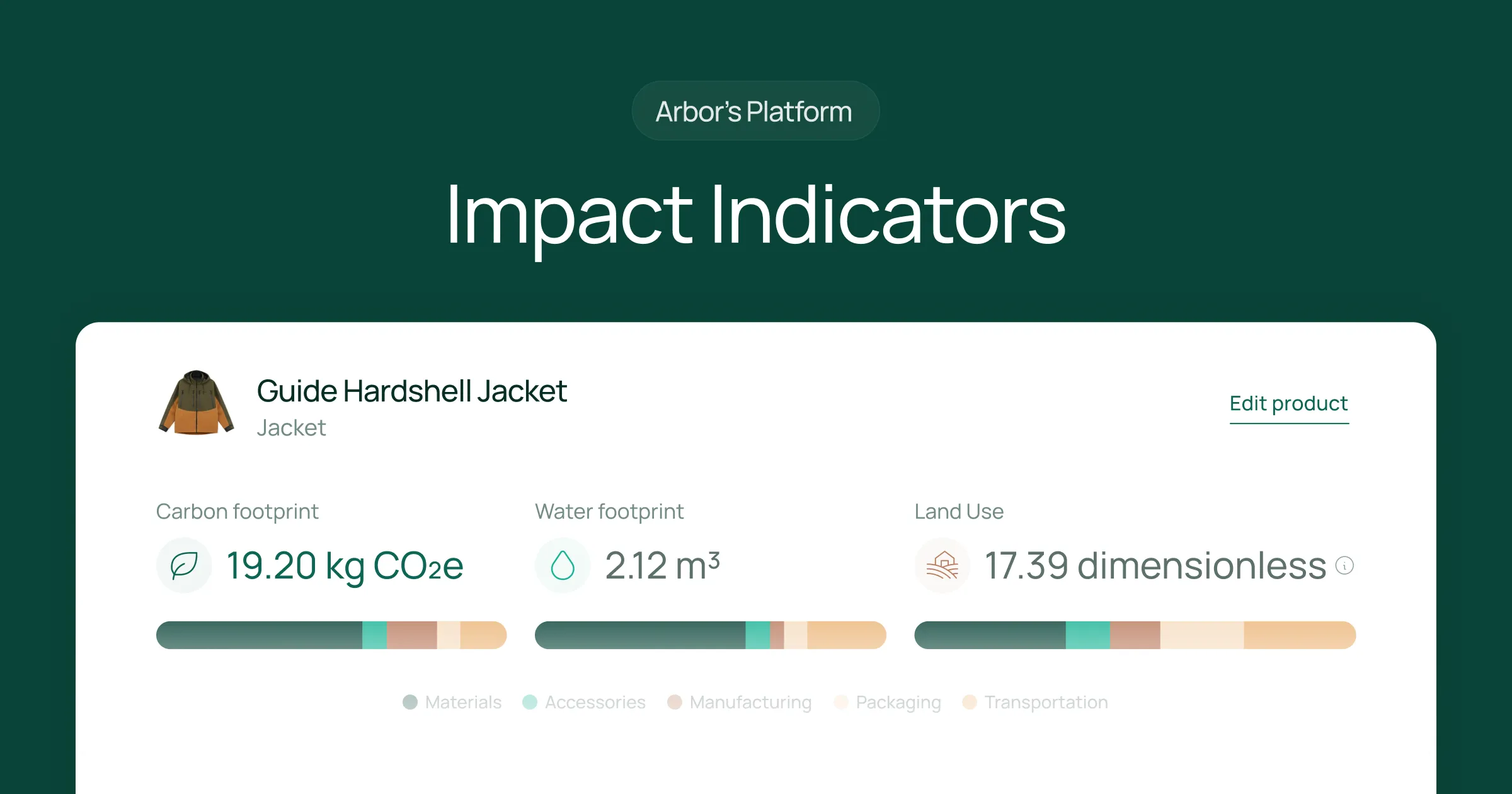
By identifying which materials, suppliers, or manufacturing processes contribute the most to your footprint, you can target specific "hotspots" for reduction. You stop guessing and start engineering.
For example, you might discover that 40% of a jacket's footprint comes from a single zipper supplier using coal-powered electricity.
With this insight, you can work with that supplier to switch to renewables or find a lower-carbon alternative.
You can also use Product Prototyping to test these designs before you ever manufacture them. This allows you to build sustainability into the product from day one.
Transparency wins contracts
Beyond regulators, your customers and partners are watching. Trust is the new currency.
- Consumer Demand: Shoppers are increasingly savvy. A vast majority of consumers say they are likely to be loyal to a brand that offers complete transparency. Brands that share product-level carbon footprints build credibility.
- Supply Chain Pressure: Large corporations are pressuring their suppliers to provide carbon data so they can meet their own Scope 3 goals. Being able to provide a fast, accurate Product Carbon Footprint (PCF) can be the difference between winning and losing a contract.
Next steps for business leaders
The regulatory environment is tightening with frameworks like the CSRD and SB 253 coming into force. Measuring carbon emissions is no longer optional.
Automated platforms like Arbor can now handle thousands of SKUs and complex supply chains in minutes.
To get started:
1. Assess your obligation
Check which regulations apply to your company's size and region.
2. Move beyond spend-based data
Start gathering physical data on materials and energy use for higher accuracy.
3. Focus on Scope 3
Recognize that your biggest risks and opportunities likely lie in your supply chain.
4. Leverage technology
Use specialized carbon accounting platforms, like Arbor, to automate the heavy lifting and ensure your data is audit-ready.
Supercharge your climate strategy and measure your emissions with Arbor
Measure your carbon emissions with Arbor
Simple, easy carbon accounting.
FAQ about measuring carbon emissions
What is carbon emissions reporting?
Carbon emissions reporting is the process of measuring and disclosing an organization's greenhouse gas emissions. This typically follows standards like the GHG Protocol and includes direct emissions (Scope 1), energy emissions (Scope 2), and value chain emissions (Scope 3).
How to reduce carbon emissions in business?
Businesses can reduce carbon emissions by measuring their footprint to identify "hotspots" and then implementing changes such as switching to renewable energy, optimizing supply chain logistics, or redesigning products with lower-carbon materials.
Why should I use activity-based data instead of spend-based data?
Spend-based data estimates emissions from financial spend, which can fluctuate with prices and obscure the true impact. Activity-based (bottom-up) data uses physical quantities and specific emission factors, providing a more accurate, audit-ready view of your actual environmental performance.
What are carbon emissions vs. greenhouse gases?
Greenhouse gases (GHGs) are the physical compounds (like CO2, Methane, Nitrous Oxide) that trap heat. "Carbon emissions" is a general term often used to describe the release of these gases, which are typically measured in "CO2e" (Carbon Dioxide equivalent) to create a standard unit for reporting.

.webp)
%20Directive.webp)

.webp)



%20Arbor.avif)


%20Arbor.avif)
.avif)

%20Arbor%20Canada.avif)
.avif)
%20Arbor.avif)
.avif)

_.avif)
.avif)
%20Arbor.avif)


%20Software%20and%20Tools.avif)


.avif)
.avif)


%20EU%20Regulation.avif)




.avif)


%20Arbor.avif)




_%20_%20Carbon%20101.avif)


.avif)


